Seth A. Goodall is the New England Regional Administrator for the U.S. Small Business Administration. We run into him frequently when he comes to New Hampshire. -Ed.
Millennials, born between 1980 and the mid-2000s, are the largest generation in the U.S., representing one-third of the total U.S. population in 2013.
Millennials are a technologically connected and diverse generation. Their unprecedented enthusiasm for technology has the potential to spark change in traditional economic institutions and the labor market. The priority that millennials place on creativity and innovation make them an important engine for the U.S. economy for decades ahead.
Millennials were born to be entrepreneurs and at SBA in New England, we’re making millennial entrepreneurship dreams come true. For example, in Center Ossipee, NH, millennial entrepreneurs Matt Trahan and Ash Fischbein of The Sap House Meadery harnessed assistance from Kit McCormick of the NH Small Business Development Center to jumpstart their business.
It’s exciting to witness millennials becoming entrepreneurial trailblazers in our local communities and neighborhoods with SBA assistance.
Despite their promise, unemployment remains high among millennials – one in four millennials are experiencing unemployment. Millennials who grow up in underserved communities face even higher rates of poverty and unemployment. Young African-Americans and Latinos under the age of 25 are twice as likely to be unemployed.
For many young millennials of color, entrepreneurship isn’t about monetizing a hobby for some extra cash, it’s about finding a way to support themselves. Research shows that more than half of millennials are interested in starting their own business, especially African-American and Hispanic males.
That’s why the Administrator of the U.S. Small Business Administration (SBA), Maria Contreras-Sweet recently announced the My Brother’s Keeper Initiative for Millennial Entrepreneurs. It’s a new federal outreach and education campaign to help America’s millennials become what we call “enterprise-ready.”
President Obama launched My Brother’s Keeper to address persistent opportunity gaps faced by young people of color and to ensure that all young people can overcome challenges and achieve their potential. The President’s new economic opportunity agenda for millennials creates new policies to support this generation.
At the SBA, our message to millennials is clear. It’s a message of inclusion and possibility to help jumpstart their small business potential in where their talents and interests lie. Overall, we want to help millennials start, grow, and succeed as small business owners and we won’t charge them a dime for it.
Entrepreneurship can be the answer if your question is “What’s next for me?” If you’re a potential millennial entrepreneur or know someone that is, click here to learn more.
Small business owners from across New Hampshire will have the opportunity to meet one-on-one in two weeks with large government contractors, which, even at a time of budget cutbacks, still need goods and services provided to them.
The 2014 New Hampshire Small Business Matchmaker will run from 8:30 am to 4 pm, March 13, and is hosted by Rivier University in Nashua, with contributing support from BAE Systems, which is also an exhibitor. Over 30 prime contractors are expected, including the Portsmouth Naval Shipyard, the US Environmental Protection Agency, the New Hampshire National Guard and the US Army Corps of Engineers.
“For businesses that have products and services the government needs and wants, it is always a good time to pursue a contract,” said David Pease, program manager for the New Hampshire Procurement Technical Assistance Program. “It is a particularly good time now if you have a product or service that can save money, while meeting an established need.”
Government purchasing is a $2 billion market in the state and the NH-PTAP assists about 900 companies, of all sizes, doing business with the government and agencies that are prime contractors for government.
“Matchmakers are very important to us,” said Susan King, the executive administrator of supplier diversity for BAE Systems, Electronic Systems, headquartered in Nashua, which sponsors more than 25 small business events around the country and spends about $400 million buying goods and services from small businesses. “It lets us meet face-to-face with small businesses and to talk with them about what they offer.”
The New Hampshire Small Business Matchmaker is the only one scheduled this year and Pease said it is a rare opportunity for businesses to meet with decision makers in one place, rather than spend time trying to connect with the right person. Government agencies need to purchase the same kinds of goods and services as private businesses do, Pease said. With its own set of goals, statutes and procedures that must be followed, government procurement can be an intimidating process to those who are new to it.
In addition to meeting with the prime contractors, businesses attending can network with others, meet with and get advice from a business mentor and attend information sessions.
Those interested in attending can register online at www.NHSBDC.org. The cost is $50 and includes lunch. For more information, call Heidi Edwards Dunn at the New Hampshire Small Business Development Center at 603-271-0417.
Small businesses interested in learning more about the wide-ranging effects of the Affordable Care Act are invited to a free forum scheduled for Thursday, Aug. 8 at the Southern New Hampshire University Dining Center Banquet Facility.
Countdown to Oct. 1, 2013: The Affordable Care Act and Your Small Business will provide all of the information New Hampshire companies will need to comply with the employer mandate to offer health coverage to employees. Topics to be discussed include coverage for dependents and spouses, qualifications for the health premium tax credit, the composition of the new health exchange and the portion of insurance costs employers will be obligated to pay.
Athough many of the concepts explored will center around small business, larger employers will also find this conference helpful.
Tom Raffio
“This is a great opportunity to get ahead of the curve and learn how your company will be affected by this legislation,” said Northeast Delta Dental President and CEO Tom Raffio. (Read his guest blog on the topic.) “Having the right information prior to the introduction of the Act is crucial and we look forward to educating as many small businesses as possible with the help of some top industry experts.”
Presenters will include New Hampshire Insurance Department Commissioner Roger Sevigny, as well as representatives of the U.S. Small Business Administration, Northeast Delta Dental, Harvard Pilgrim Health Care, Anthem Blue Cross Blue Shield and Great New Hampshire Restaurants, Inc.
The forum is presented by the Center for Women’s Business Advancement at Southern New Hampshire University in coordination with Northeast Delta Dental, WGIR-AM, the Greater Manchester Chamber of Commerce, the Greater Concord Chamber of Commerce, the New Hampshire Division of Economic Development, Southern New Hampshire University and New Hampshire Business Review.
Monday started off quite nicely, thank you, with the announcement that New Hampshire will receive nearly $300,000 for the second year of funding of the State Trade Export Promotion.
This money will be used just like the acronym says – to help small businesses here in the Granite State take a STEP toward exporting their products overseas.
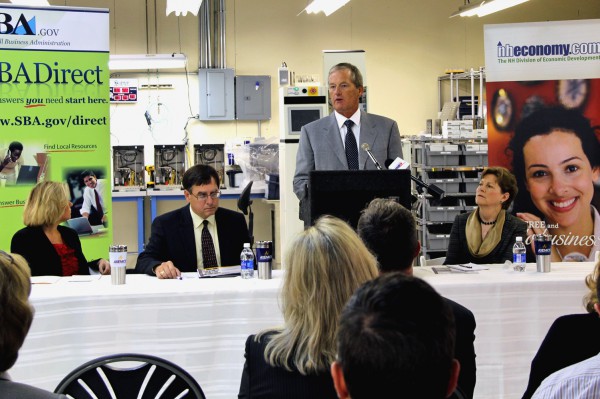
The announcement, which included remarks from US Sen. Jeanne Shaheen and Jeanne A. Hulit, the Small Business Administration’s Associate Administrator for Capital Access, was made at Axenics inNashua, a small manufacturer that makes specialized assemblies, clean piping products and gas systems. Right now, the company exports less than 10 percent of its annual sales, but it has worked with the International Trade Resource Center and made use of funding in the first year of the grant to investigate and increase its export potential.
“STEP is working for us,” said Haywood Schmidt, president of Axenics, who added that the 28-year-old company intends to grow over the next two years and create 35 new jobs.
Christopher Way, interim Director of the Division of Economic Development, said the STEP program, at the conclusion of its first year, “has provided a valuable infusion of assistance to small businesses and funding for state export programs.”
In the first year of the STEP program, 24 New Hampshirecompanies received assistance from the grant and in the second year, that will continue. Matching grants will be available to qualified businesses to offset the cost of export promotion, including tradeshow fees, translation of websites and developing marketing materials.
On Thursday, representatives of six New Hampshire companies, including Axenics, Corfin Industries of Salem, EPTAM Plastics of Northfield, Orion Wire of Haverhill, Tech Resources of Milford and Wall Industries of Exeter, head to Montreal.
Gov. John Lynch is leading the Aerospace and Tourism Trade Mission on Thursday and Friday, during which the Granite Staters will take part in the Montreal Aerospace Global Supply Chain Summit .
By stepping up to this mission, the participating companies will receive a wealth of information and make valuable connections that will, ultimately, open trade opportunities.
“Those of you familiar withNew Hampshire government know one thing – we don’t like to sit on the sidelines and our businesses have no interest in standing still while the global economy swirls around us,” Way said. “ This is why STEP is important.”
W.S. Badger Co., in Gilsum, NH, worked with the Office of International Commerce to research potential export markets.
Like many small business owners, Kathleen Johnson juggles everything from overseeing the manufacturing process to marketing her product, Lickity Bits.
Located up in the North Country town of Columbia, it caters to owners of horses by encouraging horses to accept bits. She has a niche product, but knows that she could grow … well … unbridled … especially outside the U.S.
“As a small business owner, it is a daunting task trying to navigate through international markets that may be available,” Kathleen said.
That’s where the Office of International Commerce stepped in and provided her with comprehensive information about a possible export market.
“We learned that Brazil is a potentially key market for us, since it has the third highest horse market worldwide and prospering economy,” she said.
The OIC received a grant from the Eastern Trade Council to provide market research about the Brazilian market to her and several other businesses.
Why Brazil? The South American country has the seventh largest economy in the world, which is weathering the global economic challenges better than other parts of the globe. With a diversified economy and an expected surge in infrastructure improvements from now until the 2016 Summer Olympics being held there, U.S.exports are increasing rapidly.
“In a very competitive market, (the research) located one company interested in receiving information from WMI,” said Frank Morabito, the company’s international sales product manager.
Out in the Monadnock region, W.S. Badger Co. makes organic body care products, employing about 40 people at its new Gilsum plant. No stranger to the OIC, it has worked several times with the staff, most recently to help find a distribution partner in Russia.
“This service proved itself very valuable, as it allowed us to enter the market with a company that is screened and trusted,” said Stephanie Ritchie, Badger’s international accounts manager. “Our sales have grown slowly, but steadily, and we look forward to continuing to expand our business inRussia.”
If your company is considering exporting, you may be eligible for a grant that will pay for market research. The funds are part of the State Trade Export Promotion grant, which will, for qualifying businesses, provide these services at no cost. Available through the U.S. Commercial Service, the research usually costs between $500 and $750.
Orders for the services must be placed by mid-September. For more information, contact Kasim at 603-271-8444 or email Tina.Kasim@dred.state.nh.us.
Three thousand miles from and five hours ahead of New Hampshire, the Farnborough International Air Show is open for the second day. Noisy and exciting, the trade show is a global showcase for the aerospace industry and the Granite State is a part of it all.
Thanks to a State Trade and Export Promotion (STEP) grant, Corfin Industries of Salem and EPTAM Plastics of Northfield are joined by other aerospace and defense companies from Maine and Vermont in our own Best of New England booth and, may we say, holding our own with the presence of larger states who are touting their industries.
At the opening ceremony Monday in front of the US Pavilion, Under Secretary of Commerce for International Trade Francisco Sanchez spoke of the critical importance of aviation to the economy, noting that it contributed $86 billion in export sales to the US economy and a positive trade balance of $47 billion.
For our two manufacturers joining us on this trade mission, Farnborough is a chance for them to connect and make connections globally, which will lead to orders for their products and services, keep their companies strong and their businesses reaching new heights.
The sun is out today in Farnborough. The morning’s shift of airplanes and preparation for aerial displays is drowning out conversation.
It’s a pretty good day.
Throughout the day, we’re posting updates and photos on our Facebook page.
The U.S. Small Business Administration is seeking nominations for awards honoring the critical economic role small businesses play in federally funded research and development through SBA’s Small Business Innovation Research (SBIR) and Small Business Technology Transfer (STTR) programs.
Three awards will be given, one for companies that have participated in the SBIR/STTR programs, one for individuals who advocate on behalf of the programs, and a third “Hall of Fame” award recognizing companies that have an extended period of extraordinary success of research, innovation, and product commercialization within the SBIR or STTR program.
The Tibbetts Awards are named after Roland Tibbetts, who was instrumental in developing SBIR, a highly competitive program to ensure small businesses get a chance to compete for federal research and development funding, along with the opportunities it provides to profit from commercialization of the technologies they develop.
The SBIR and STTR programs currently account for more than $2.5 billion per year in federal R&D funds and are coordinated by the SBA in cooperation with 11 other federal agencies with large external research and development budgets.
The awards are presented to companies and individuals that are beacons of promise and models of excellence in high technology. Typical of past award winners are a Maine company that created a self-propelled and eco-friendly “AquaPod” for sustainable aqua-culture. A previous Hall of Fame award winner that won numerous SBIR grants – a major west coast chip manufacturer – started with a staff of 35 and has expanded to a global work force of 17,500.
Selections for Tibbetts Awards are based on several factors, including the economic impact of the technological innovation, overall business achievement and demonstration of effective collaborations.
Nominations for these awards opened December 15, 2011 and will close 5 PM EST on January 31, 2012. Awards will be presented in Washington, DC, in April 2012. To submit a nomination, please visit tibbetts.challenge.gov (Tibbetts Awards – companies and individuals) and sbirhof.challenge.gov (Hall of Fame Awards).
Have you ever wondered about how a competitor received a contract with a federal or state agency?
Does the thought of selling your product or service to state, local or government agencies cause you to sweat and worry about an endless stream of expensive and complicated paperwork?
If you wanted to begin, where would you even start and who could you ask for honest advice?
On December 15th, the New Hampshire office of the U.S. Small Business Administration (SBA) and the NH Procurement Technical Assistance Program (NH-PTAP) will present their first of several “Everything You Want to Know About Government Contracting But Were Afraid to Ask!” roundtable sessions for small business owners or key employees in small businesses who are thinking about joining the hundreds of New Hampshire small businesses who sold over $275 million dollars in goods and services to federal agencies.
According to Dave Pease, Program Manager of the NH-PTAP, “The companies that have achieved success in selling to federal or state agencies or large federal contractors have several things in common. They all have asked questions, they all have experienced frustration at some point and they all have persevered with a winning bid or proposal.”
At the upcoming roundtable business owners will hear contracting specialists discuss real and perceived barriers that businesses encounter as well as strategies and supportive resources you can use to overcome barriers and gain access to these opportunities.
Thursday, December 15, 2011
1:00 p.m. to 3:00 p.m.
The New Hampshire Innovation Commercialization Center Conference Room
75 Rochester Avenue
Portsmouth, NH 03801
This session is offered free of charge, but space is limited. Please contact Rachael Roderick at 603 225-1603 or rachael.roderick@sba.gov to register.
Psssssssssssssssstttttt……buy local, buy American and buy often. Here are a few press releases that can assist you in this endeavor.
Make a Difference on Small Business Saturday®
As a proud supporter of Small Business Saturday®, a day dedicated to supporting small businesses on one of the busiest shopping weekends of the year, the U.S. Small Business Administration is encouraging every American to support small businesses by doing some of their holiday shopping on the Saturday after Thanksgiving at small businesses.
This year’s Small Business Saturday® is Nov. 26, 2011.
“Small businesses are the foundation of our economy – half of America’s workers either own or work for a small business,” said SBA Administrator Karen Mills. “Small Business Saturday® is an opportunity to show our support for our friends and neighbors who throughout the year are growing our local economy, as well as supporting many local initiative and organizations.”
Nov. 26 marks the second annual Small Business Saturday®, a day to support the local small businesses that create jobs, boost the economy and preserve neighborhoods around the country. First there was Black Friday, and then Cyber Monday, and now Small Business Saturday® will help drive shoppers to America’s job creators. Small businesses have generated two out of every three net new jobs over the past 15 years and employ over half of all private sector employees.
For more information on how to support Small Business Saturday® in your area, or to get great Small Business Saturday® marketing tips and resources, check out www.sba.gov/saturday or visit Facebook.com/smallbusinesssaturday and follow us on Twitter @SBAgov, #SmallBizSat.
NH Made Gifts Available
Our NH Made Stores on I-95 in Hampton are brimming with NH-made food items and handcrafted products. The stores will be closed Thursday for Thanksgiving but open Friday, Saturday and Sunday and daily through Christmas. You can also shop online from the convenience of your home at www.nhmade.com and choose “Shop Online.”
Wild Orchard Guest Farm
NH Made Members Working with Members: Shop, Sip, Primp 2011 At the Wild Orchard Guest Farm, 67 Candia Rd., Deerfield NH on Saturday, November 26th from 4-8pm. After the busy Thanksgiving holiday, enjoy complimentary hor d’oeuvres and drinks while relaxing with friends before a crackling fire. Pamper yourself with a complimentary manicure from Fancy Nails Spa and Boutique. Tour the Inn’s magnificent rooms and lovely grounds. Gaze at the stars from the cozy depths of the outdoor Jacuzzi! While treating yourself, you’ll also have the opportunity to browse local artist’s creatively displayed holiday offerings. Talented artists and vendors showcasing their goods and services are: Bead Bush Studio jewelry, Divine Detailing auto detail, Fancy Nails Spa and Boutique, Ed Gerhard guitar cds, Teresa Harris Jewelry Designs, Barbara King knitted designs, Mystic Lifestyles textiles, Nicola King Designs bags and accessories, Northwood Naturals bath and beauty, Simple Pleasures photo cards and soy candles, Kristy Stevens ornaments, Tattered Rabbit Farm birdhouses, Wild Orchard Guest Farm crafts. Interested in making the night a true get-a-way? Call Molly at 603-261-7742 or www.wildorchardguestfarm.com for reservations.
Thirteen businesspeople were honored Thursday night at the New Hampshire Business Review’s ninth annual Business Excellence Awards, which recognize the efforts and achievements owners and operators of companies with 100 employees or fewer.
More than 300 people attended the Oct. 27 event, which was held at the Radisson in Manchester.
NHBR also announced two inductees into the Business Excellence Hall of Fame, which singles out people whose entire careers have been marked by a consistent and impressive record of accomplishments, both in their chosen fields, in their communities, and across the state and beyond. These honorees were selected by a separate panel of judges.
The 2011 Hall of Fame inductees were Howard Brodsky, co-founder of CCA Global Partners, one of the largest privately held companies in the United States and one of the largest cooperatives in the world, and the Singer Family, owner of Merchants Automotive Group, a multifaceted, $200 million auto company, including a long-term fleet leasing division that is one of the largest in the Northeast.
“Each of the businesspeople who receive these honors has a different story to tell,” said Sharron McCarthy, president of McLean Communications and publisher of NHBR. “But what they have in common is determination, industriousness and the ability to come up with innovative solutions that have allowed their businesses to survive and thrive, regardless of economic conditions, and a commitment to serving their communities.”
Jeff Feingold, editor of NHBR, said, “We would like to salute all of the nominees, the people who nominated them and the winners themselves for their contributions toward making New Hampshire a great place to do business.”
Emcee was Erin Fehlau, WMUR’s weekday morning and noon news anchor. A portion of the proceeds from the evening benefited Court Appointed Special Advocates, or CASA, which advocates for New Hampshire children in the state’s court system in cases of neglect and abuse.
The winners of the 2011 NHBR Business Excellences Awards were:
Excellence in Business Services — Guy Sylvester, Absolute Resource Associates, Portsmouth
Excellence in Construction (tie) — Jerry Kingwill, Cobb Hill Construction, Concord; Jason Foster, Foster’s Professional Painting Plus LLC, Claremont
Excellence in Financial Services — Michael L’Ecuyer, Bellwether Community Credit Union, Manchester
Excellence in Health Care — Paula Gagne, Regency Nursing Care, Manchester
Excellence in Hospitality — Emeran Langmaid, A&E Custom Coffee Roastery, Amherst
Excellence in Media & Marketing — Erik Dodier, PixelMEDIA Inc., Portsmouth
Excellence in Nonprofits — Brian Young, Nashua Center for the Multiply Handicapped
Excellence in Professional Services — Thomas Brueckner, Senior Financial Resources Inc., Nashua
Excellence in Real Estate — Dick Anagnost, Anagnost Investments Inc., Manchester
Excellence in Retail (tie) — Sy Mahfuz, Persian Rug Galleries, Nashua; Lynda Nelson, Quest Martial Arts Academy, Barrington
Excellence in Technology — Cheryl Gamst, CCS New England, Nashua
The judges for the 2011 NHBR Business Excellence Awards were:
Chris Bernard, vice president, business banking relationship manager, Citizens Bank
Steve Boucher, communications manager, New Hampshire Division of Economic Development
Mary Collins, state director, New Hampshire Small Business Development Center
Bob Esau, executive vice president of Wealth Management, Laconia Savings Bank
Greta Johansson, New Hampshire district director, U.S. Small Business Administration
Patrick F. McDermott, economic and community development manager, Public Service of New Hampshire
Dr. Russ Ouellette, managing partner, Sojourn Partners, Bedford
Michele Petersen, vice president of operations, abi Innovation Hub, Manchester
Joe Reilly, cofounder and president, Centrix Bank
Chip Underhill, executive director of public relations and external affairs, Pinkerton Academy, Derry
Sponsors of the event were FairPoint Communications, Laconia Savings Bank, Harvard Pilgrim Health Care of New England, J Maze Design, Public Service of New Hampshire, New Hampshire Division of Economic Development, Merrimack Street Volvo, WGIR-AM 610 and New Hampshire Public Television.
On behalf of all of us at the New Hampshire Division of Economic Development, thanks to our friends at the New Hampshire Business Review for a great awards celebration and congratulation to the winners and nominees!!









 Three awards will be given, one for companies that have participated in the SBIR/STTR programs, one for individuals who advocate on behalf of the programs, and a third “Hall of Fame” award recognizing companies that have an extended period of extraordinary success of research, innovation, and product commercialization within the SBIR or STTR program.
  Does the thought of selling your product or service to state, local or government agencies cause you to sweat and worry about an endless stream of expensive and complicated paperwork?
  “Small businesses are the foundation of our economy – half of America’s workers either own or work for a small business,” said SBA Administrator Karen Mills. “Small Business Saturday® is an opportunity to show our support for our friends and neighbors who throughout the year are growing our local economy, as well as supporting many local initiative and organizations.”
 More than 300 people attended the Oct. 27 event, which was held at the Radisson in Manchester.